
Keller provided the foundations for the Thameside Energy Recovery Facility, a new waste-to-energy plant being built by Viridor at Essex's Tilbury Docks.
The project
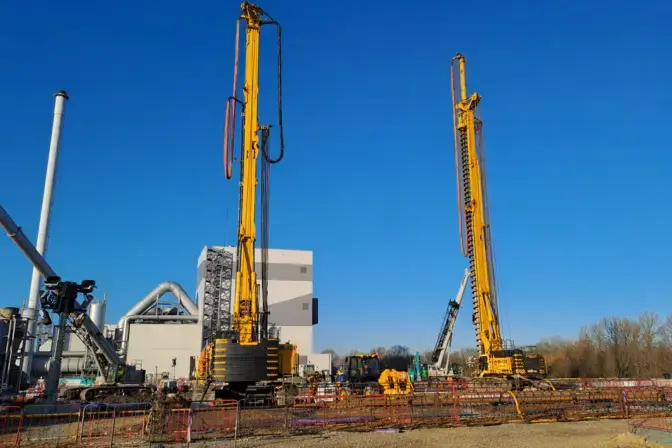
More than 1,000 continuous flight a(CFA) piles and precast driven piles were used to support the substantial loads of the facility, which will generate energy to power 93,000 homes.
Some of the CFA piles were up to 1050mm in diameter and reached depths of 36 metres.
Keller was selected by Kanadevia Inova as the principal contractor for the facility, with Viridor, one of the UK’s leading waste management companies, targeting a start of commercial operation in 2028.
The challenge
The size and technical demands of the project called for detailed planning and careful coordination throughout.
The foundation solution needed to withstand significant compressive, tensile and lateral forces generated by the ERF structure, while also accounting for the site's chalk ground conditions.
Piling works were closely integrated with a phased construction programme, requiring activities to be carefully sequenced to support the client's zone-by-zone delivery approach and maintain access for follow-on trades.
At the same time, attendance works had to be coordinated alongside the piling operations to keep the project running smoothly.
The solution
Keller's geotechnical and structural design specialists worked hand in hand with the site team to develop a foundation solution that met the project's technical requirements.
By bringing design and construction expertise together from the outset, the team was able to refine the solution through value engineering, improving buildability, reducing material consumption and maintaining the required structural performance.
The foundations were installed using high-capacity CFA piling rigs fitted with continuous monitoring technology, allowing key installation data such as penetration rates, torque, concrete volumes and reinforcement placement to be tracked in real time.
This provided confidence that each pile was constructed to the specified design and quality standards.
A comprehensive testing programme was carried out throughout the works, including pile integrity, dynamic load and static load testing, to verify foundation performance.
In addition to the piling works, Keller managed all associated enabling and attendance activities, including piling platform construction, surveying, plant support, muck-away operations and site logistics.
This coordinated approach helped maintain productivity across the site and ensured the project progressed smoothly from start to finish.