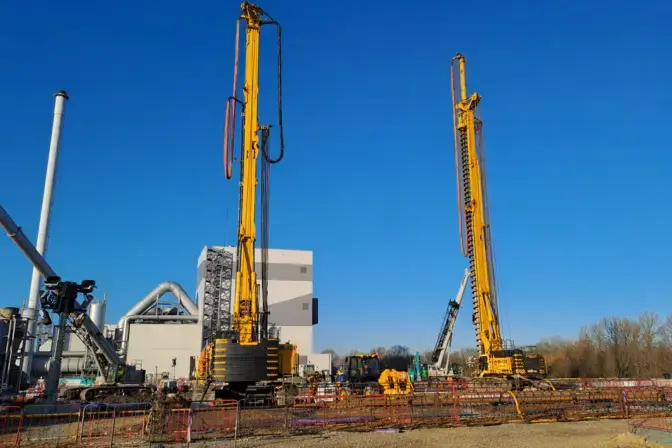
Continuous flight auger (CFA) piles are drilled and concreted in one continuous operation enabling much faster installation time than for bored piles. Reinforcement is placed into the wet concrete after casting, enabling the pile to resist the full range of structural loading.
Process
CFA piles are constructed by rotating a hollow stem continuous flight auger into the soil to a designed depth. Concrete or grout is pumped through the hollow stem, maintaining static head pressure, to fill the cylindrical cavity created as the auger is slowly removed. The reinforcement cage is placed through the freshly placed concrete. Typically, Keller CFA piles are reinforced with a rigid six metre-long cage as a minimum, but it’s possible to install much longer cages as and when required by the design or specification. If required, a specially developed vibrator unit can help accurately locate the reinforcement cages.
Specialist Contact | Richard Smith - [email protected] - +44 (0)7918 632800
Common uses
- Provide structural support
- Provide earth retention, especially on site boundaries or close to adjacent buildings
- Prevent landslides or protect existing buildings and are often combined with other techniques such as ground anchors or soil nails
- Infrastructure projects such as tunnelling, road or bridge construction as well as flood protection
Advantages
- Resists compressive, uplift, and lateral loads
- A cost efficient foundation solution
- Can be installed in most soil conditions such as sands, clays, silts, gravels and soft rock
- Can achieve pile depths up to 32m and with various diameters of 300 mm to 1000mm+
- Low noise levels and no vibration so ideal in built-up areas with weak soil conditions and high levels of ground water
- Compared to bored piles, construction is very quick as temporary casings or support systems are not required
Quality assurance
Close control of the installation process is essential to ensure the highest quality pile construction.
All Keller CFA rigs are equipped with sensitive state-of-the-art instrumentation that monitors all aspects of CFA piling, including pile depth, auger rotation, penetration rate, concreting pressure, extraction rate and over-break. The instrumentation produces an individual log for each pile that includes element identification, date, time and operator details.
This is reinforced by a documented Quality Management System procedure.
Quality assurance is achieved through a range of non-destructive testing methods to evaluate both pile integrity and/or load-settlement performance. Selection of verification technique is project and application specific.
Related techniques
Related solutions
Related resources
Related projects
Commercial
Grandidges Quay
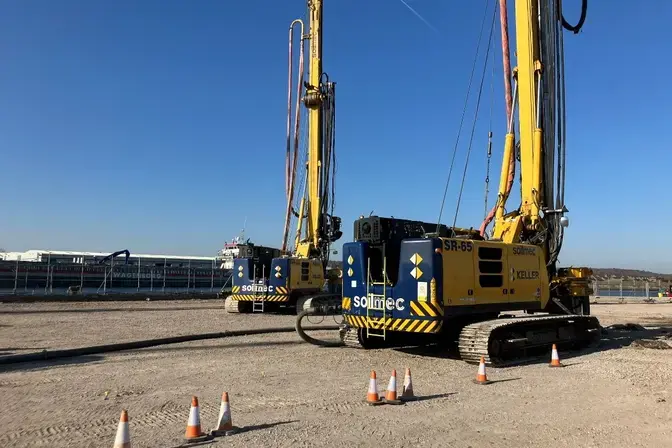
Keller were contracted by Glencar Construction Limited to provide a combination of both rigid inclusions and CFA solutions. Keller offered a fully displacement solution for the warehouse & sprinkler tank areas and Installed CFA piles for the crane base area next to a sensitive Dock Wall. This facilitated the adoption of a ground bearing floor slab and Keller switched the rigs between RI & CFA methods to optimise programme.
Commercial
Alexandra Dock
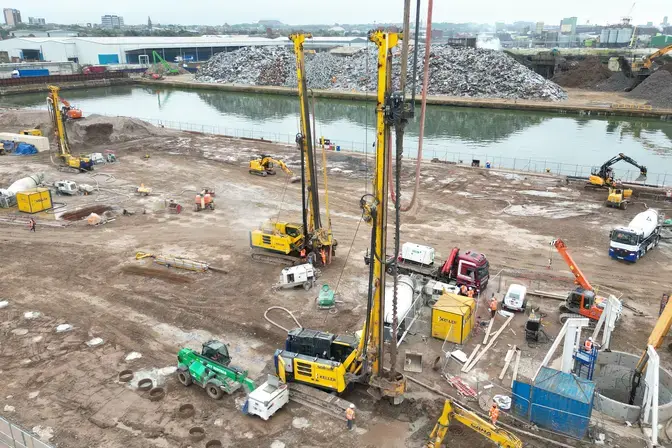
Peel Ports Group invested £28 million on a new facility at the Port of Liverpool. The new facility, referred to as Alexandra Dock Multi-User Warehouse (MUW), will be able to store a variety of commodities and will also have 300 metres of dedicated quayside and state-of-the-art cranes to optimise vessel discharge.
Commercial
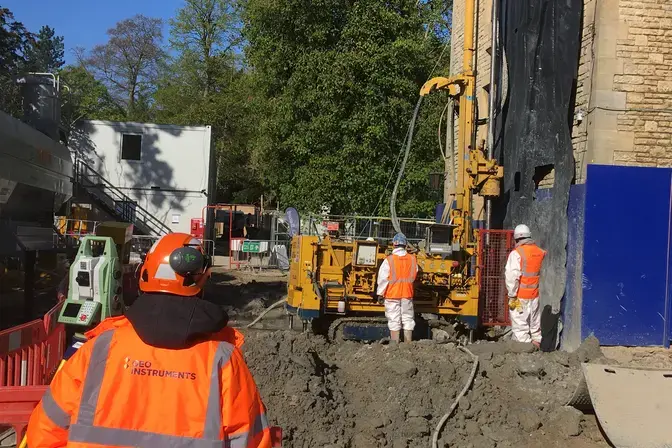
Rhodes House Redevelopment
GEO-Instruments have been working alongside their Keller colleagues on the £37m redevelopment of an historical building in Oxford.
Industrial
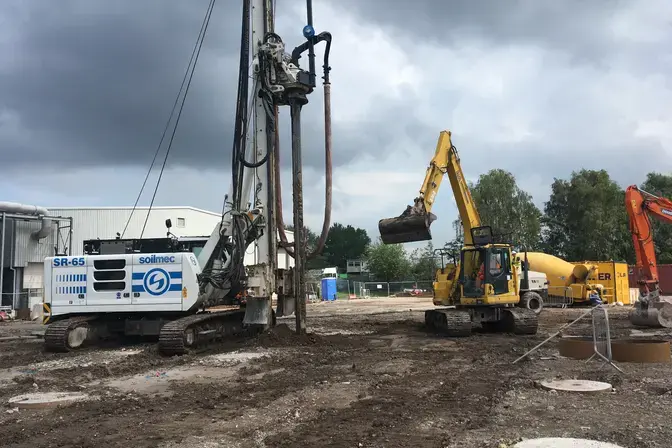
Recycling facility, Reliance Street
Suez Recycling & Recovery UK were redeveloping and expanding an existing waste recycling facility in Newton Heath, Manchester.
Infrastructure
South Cliff Stabilisation Scheme
Scarborough Spa is a Grade II listed building in South Bay, Scarborough, North Yorkshire, which is used as an events and entertainment venue. Work was needed to stabilise the cliffs behind Spa to prevent any future collapse.