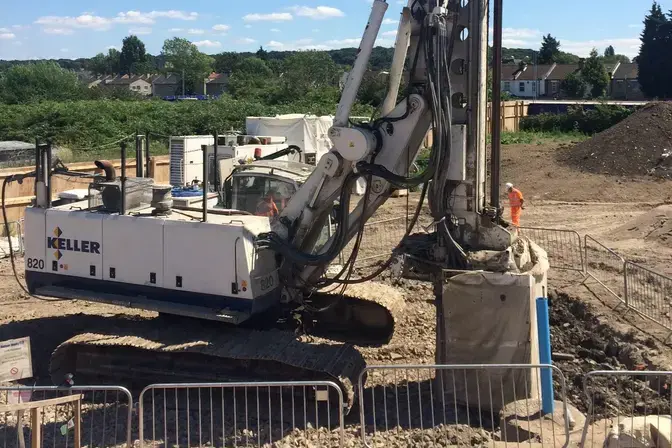
Dry soil mixing is a ground improvement technique that improves soft, high moisture clays, peats, and other weak soils, by mechanically mixing them with dry cementitious binder.
Process
To construct the columns, a high-speed drill advances a drill rod with radial mixing paddles near the bottom of the drill string into the ground. During penetration, the tool shears the soils to prepare them for mixing. After the tool reaches the design depth, the binder is pumped pneumatically through the drill string to the tool, where it is mixed with the soil as the tool is withdrawn.
The dry soil mixing process constructs individual columns, rows of overlapping columns, or 100% mass stabilisation, all with a designed strength and stiffness.
Specialist Contact | Mark Williams - [email protected] - +44 (0)7557 033271
Common uses
- Applicable in soils that have a high moisture content, and often used in high groundwater conditions, to allow chemical reaction of the soil and groundwater with stabilising binders injected in dry form
- Increase bearing capacity
- Decrease settlement
- Mitigate liquefaction
- Fix contaminants in situ
- Increase site global stability
Advantages
- Quiet and vibration free
- Environmentally-friendly as uses readily available materials
- Almost no spoil
- Operations can be done at low temperatures
- Can replace more expensive deep foundation methods
- Flexible in application
- Reduces construction time
Quality assurance
Quality is controlled and assured through column installation protocols and the results of laboratory and field-verification tests. Each column is provided with a chart-log, which typically comprises: column number, mixing tool details, mixing depth, mixing time, slurry specification, injection flow rate and pressure, total volume of slurry used, mixing tool velocities and rpm during penetration and withdrawal and torque of the shaft.
The mixing energy and binder content is calculated from this information to match design requirements.
Specimens of stabilised soils for testing are usually obtained from fresh columns with a wet grab.
Advanced core drilling and other field-testing methods can also be used to obtain specimens and to inspect the continuity, uniformity and stiffness of deep soil mixing columns. The selection of suitable verification methods depends on their relevance, accuracy and applicability in relation to the purpose and pattern of soil treatment and design properties of stabilised soil.
Related techniques
Related solutions
Resources

Related projects
Infrastructure
Betley Waste Water Treatment Works
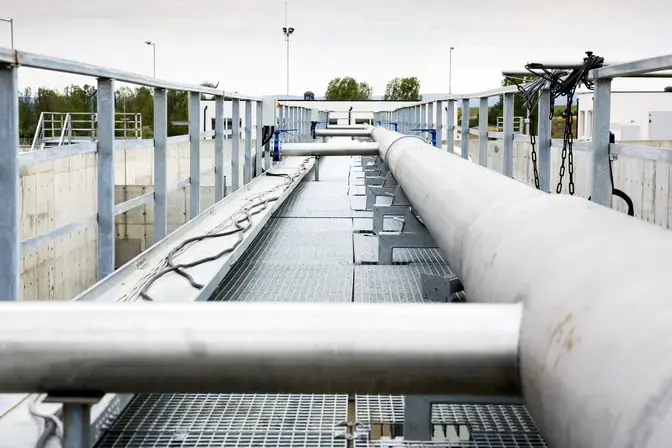
Keller were called in to offer a foundations solution for the installation of 1.0m diameter waste water pipe as part of the Betley WwTW project.
Infrastructure
Crossrail C298
Crossrail is the largest construction project in Europe. It involves the construction of 42km of twin underground railway tunnels and 10 new stations across 40 construction sites.