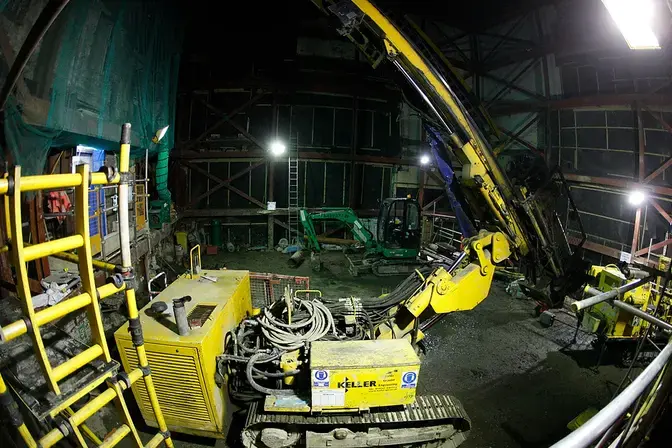
Jet grouting uses high velocity fluid jets to construct cemented soil of varying geometries in the ground.
Process
Jet grouting creates in situ columns of soilcrete (grouted soil), using a grouting monitor attached to the end of a drill stem. The jet grout monitor is advanced to the maximum treatment depth. Then high velocity jets (cement grout with optional water and air) are initiated from ports in the monitor. The jets erode and mix the in situ soil with grout as the drill stem and monitor are rotated and raised.
Depending on the application and types of soils, one of three variations is used: the single fluid system (slurry grout jet), the double fluid system (slurry grout jet surrounded by an air jet) and the triple fluid system (water jet surrounded by an air jet, with a separate grout port). The jet grouting process constructs soilcrete panels, full columns, or partial columns with designed strength and/or permeability.
The soilcrete geometry and physical properties are designed based on the in-situ soils. Because it is an erosion-based system, soil erodibility plays a major role in predicting geometry, quality, and production. Cohesionless soils are typically more erodible by jet grouting than cohesive soils.
Specialist Contact | Bruce Stephenson - [email protected] - +44 (0)7918 193001
Common uses
- Often the preferred solution in any situation requiring control of groundwater or excavation of unstable soil (water-bearing or otherwise)
- Underpin foundations such as quay walls and heavy structures
- Provide excavation support
- Seal the bottom of planned excavations
Advantages
- Effective across the widest range of soil types of any grouting system, including silts and most clays
- Ability to construct soilcrete in limited spaces and around subsurface obstacles such as utilities, provides unique design flexibility
- Low headroom equipment enables construction of soilcrete in limited spaces such as basements
- Ability to work around subsurface obstacles such as utilites, provides unique design flexibility
- Can target specific soil layers at depth without having to treat soils above
- Can often result in construction schedule savings
- Can usually be done without disrupting normal facility operations
- Containerised, highly mobile support equipment reduces mobilisation and demobilisation costs and time
Quality assurance
With 40 years of experience, working across the globe, Keller has seen and completed more jet grouting projects than any other contractor in the world.
In addition, constant improvements in technology, such as Keller’s proprietary method of determining column diameter: the Acoustical Column Inspector or ACI, ensure project requirements are met.
Related techniques
Related resources
Related projects
Commercial
Rhodes House Redevelopment
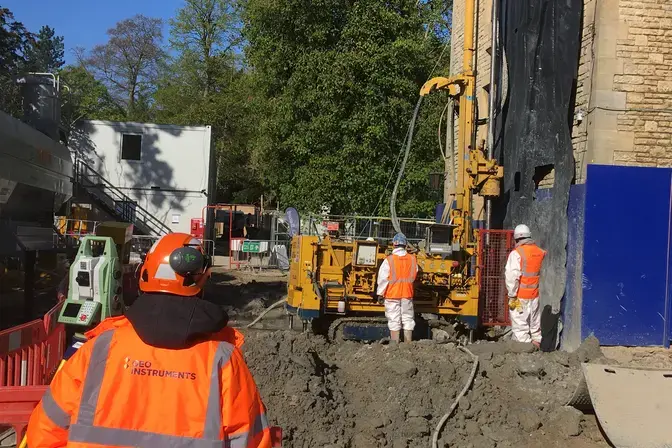
GEO-Instruments have been working alongside their Keller colleagues on the £37m redevelopment of an historical building in Oxford.
Infrastructure
Thames Tideway
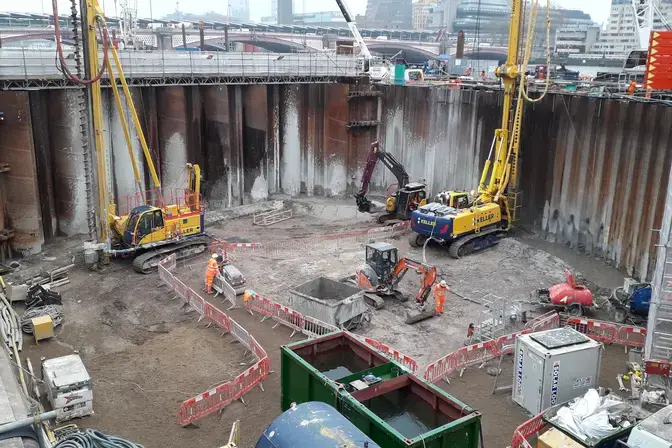
The Thames Tideway is a 25km long tunnel running mostly along the line of the River Thames through central London. It will provide capture, storage and conveyance of almost all the combined raw sewage and rainwater discharges that currently overflow into the river. The Blackfriars Bridge Foreshore worksite included the construction of a drop shaft for a Tunnel Boring Machine.
Infrastructure
Secant box test pit
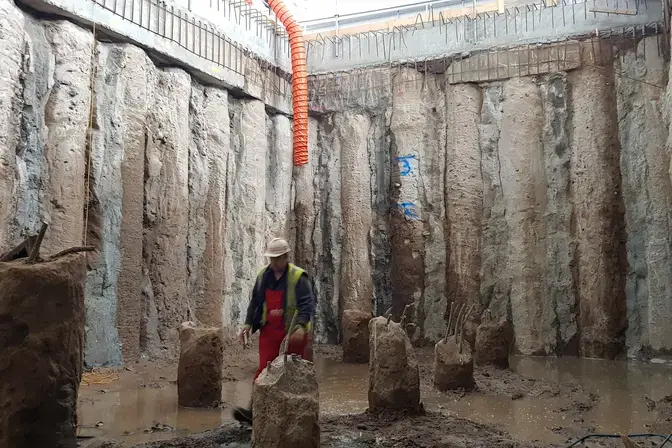
Keller UK called on the expertise of colleagues from abroad to come up with an innovative solution to create an underground testing pit at and oil and gas facility.
Commercial
Marble Arch Place
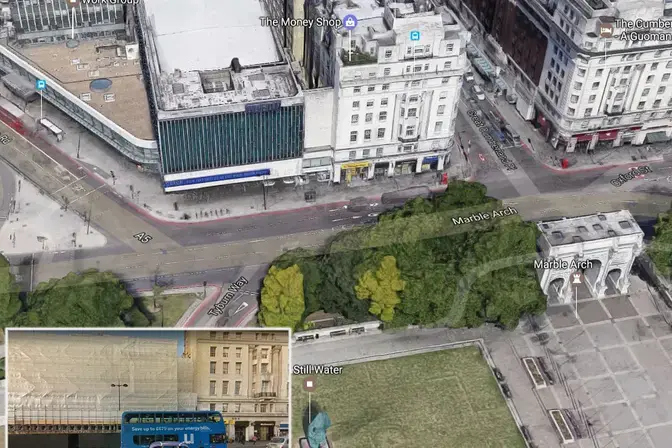
To the north of Park Lane overlooking Hyde Park, the £400million Marble Arch Place development is one of the most prestigious recent construction projects in London. Two Keller UK divisions worked together on this job to carry out underpinning and monitor the work to check for any possible impact on an adjacent building.
Infrastructure
Victoria Station upgrade
As part of the £700m upgrade of London's Victoria Station, Keller undertook what was at the time Europe's largest jet grouting project using Building Information Modelling for plotting services, tunnels and grout columns of in 4D to avoid a myriad of services beneath the site.