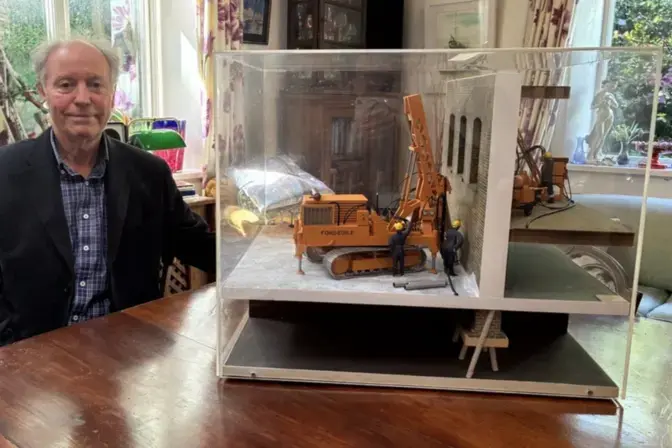
In a geotechnical career spanning more than five decades, Steve Attwood has helped to strengthen and stabilise some of the country’s most recognisable landmarks.
The Palace of Westminster, the Tower of London, the Royal Academy of Arts, London Coliseum, the National Portrait Gallery, Cutty Sark Dry Dock, The Shard, Harrods, Liverpool’s Albert Dock, Claridge’s Hotel and Ely Cathedral are just a handful of the iconic venues he has worked on.
And they all have one thing in common – Pali Radice.
Steve is regarded as the leading expert in Pali Radice, the innovative system used to help restore and stabilise buildings and monuments, which is exclusively delivered by Keller in the UK.
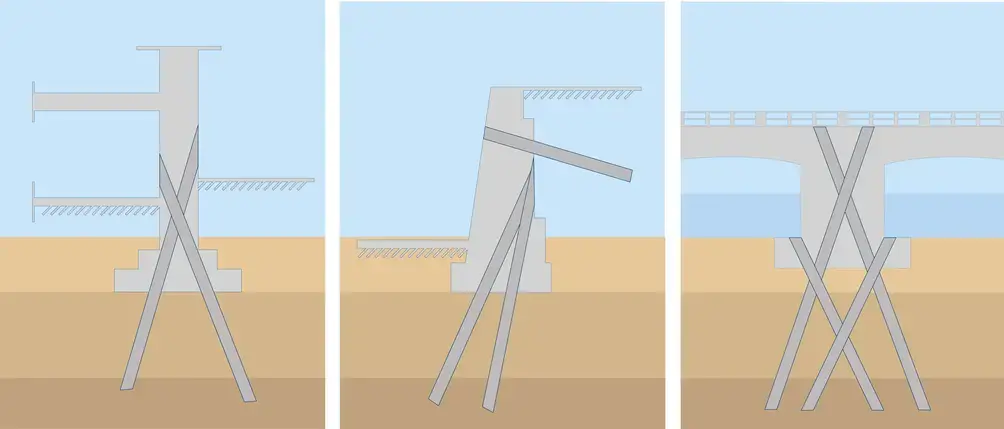
Pali Radice, meaning root piles, is a versatile foundation system using small-diameter cast-in-situ bored piles.
It has been extensively employed throughout the world to underpin or strengthen existing foundations which are settling or required to support increased loads.
Developed in the 1950s by the late Italian engineer and founder of the Fondedile organisation, Dr Fernando Lizzi, the technique has been at the heart of Steve’s career ever since he stepped foot into Fondedile’s London office in September 1974 after graduating from Sheffield with a BSc in Civil Engineering.
This followed an opportunity to work for Fondedile as a student which stimulated Steve’s interest in its appealing portfolio of projects and its offer for him to join the organisation. The rest is history.

“I did have the opportunity to join my father’s precision mechanical engineering business,” said Steve, “but I was not attracted to the factory working environment.”
Instead, Steve then spent 31 years at Fondedile Foundations Ltd, an association between Sir Robert McAlpine and Fondedile S.p.A, of Naples, where he held various roles including engineer, project manager, and senior projects manager moving progressively into design solution development, estimation and contract oversight.
In November 2005, the Fondedile franchise and plant were sold to Systems Geotechnique, and Steve became its Consultant Technical Manager for the Fondedile processes and other specialist restricted-access geotechnical work.
Keller then purchased Systems Geotechnique in April 2007, with Steve continuing in the same role.
Throughout the years, however, one thing has remained constant – Dr Lizzi’s technology.
Steve said: “Dr Lizzi’s groundbreaking geotechnical engineering system is internationally recognised to this day – and commonly used in a widening field of allied applications.
“I met him periodically from the 1970s to the early 2000s. He was a brilliant engineer, with a formidable, focused character – sometimes charming, but insistent on going the extra mile.
“His influence on my career was the importance of meshing conceptual engineering with commercial advantage – and profitability!”
Steve has seen many positive changes in geotechnics during his 52-year career, including the digital age ‘revolutionising many branches of the industry’ while there have been ‘improvements in health and safety with a focus on methodology, risk assessments, manual handling, training, and accountability’.
Dominant system
He said: “Foundation engineering, particularly in relation to inner-city developments, has upped its game significantly, especially with the increasing redevelopment of existing buildings.
"In lieu of demolition, this is becoming more common, with positive environmental impact and reuse of existing foundations.
“The development and use of CFA piling has grown exponentially and is a dominant system in a now highly competitive industry environment.”
As for the future, Steve predicts a ‘continuing trend towards specialisation’ and a ‘rethink of accepted pile design methods and standards to provide more efficient solutions’.
And what would Steve say to the next generation of geotechnical engineers who are thinking of following in his footsteps? “If you are prepared to work hard, with attention to detail, you can enjoy a very worthwhile and satisfying career.”
Perhaps one just like his own.
- This article first appeared in the Summer-Autumn edition of Keller Insight.