
Expert intervention from Keller has successfully underpinned and stabilised the foundations of a Grade I listed church.
The project
The Catholic Apostle Church, in Maida Vale, London, had been suffering from progressive settlement and structural cracking – and previous structural repair work to the building’s West Tower had failed to halt the movement.
Keller was appointed by Realtime Civil Engineering to underpin the deep mass concrete foundations and worked in collaboration with Campbell Reith to develop a tailored solution which respected the church’s architectural and heritage constraints.
The challenge
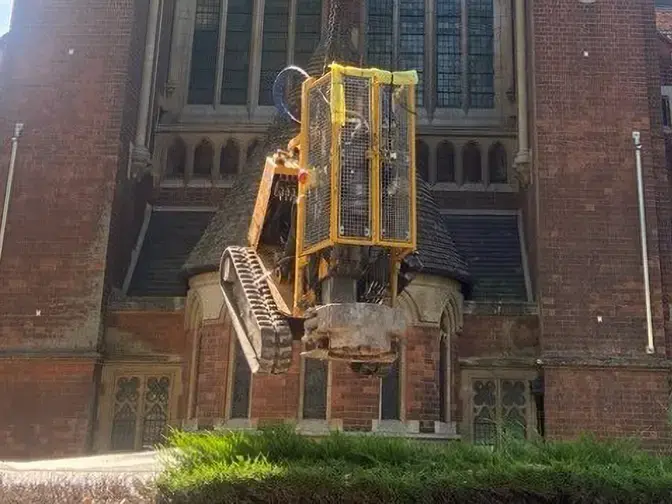
The protection of the listed masonry was addressed during the installation of 72 Pali Radice mini piles, while care had to be taken to cause minimal disruption to the church functionality and its surrounding environment.
The underpinning work was further complicated by restricted access internal headroom limited to 2.4 metres and the presence of sensitive finishes in the church.
The solution
This was based on Keller’s Pali Radice system, where alternately raking mini piles were bored through and permanently bonded to the existing foundations, extending deep into the underlying London clay.
Steve Attwood, Keller Technical Manager, said: “Working on a Grade I listed building is never straightforward, but the team approached every challenge with respect for the church’s history and fabric
“The result is a solution that strengthens the structure without compromising its character or appearance – and the professionalism shown throughout the project was exceptional.
“Despite the constraints and the complexity of the environment we were working in, the team maintained high standards and delivered a solution that protects an important landmark for generations to come.”
Keller’s work included the installation of 60 Pali Radice (root) piles and 12 load-bearing minipiles.
These were strategically positioned to support the twin towers and western end of the church, which was designed by John Loughborough Pearson and built between 1891 and 1893.
Originally developed by Italian engineer Dr Fernando Lizzi in the 1950s, Pali Radice piles are extensively employed as a stabilisation system for strengthening existing foundations which are settling or are required to support increased loads – and are used exclusively by Keller.
The piles were bored through existing foundations using temporary casings and injected with a high-strength grout which formed a permanent bond with the structure and surrounding soils.
The process effectively freezes the structure in its existing position.
The Project Manager for Realtime Civil Engineering praised the delivery from the Keller team.
They said: “A great achievement completing the piling works at the church ahead of programme, considering the environment we all had to work in.
“The importance of maintaining outputs while working in a Grade I building without causing any damage is a huge credit to how you guys undertake and deliver your works.”